


My experience after the event in Brisbane– yIGF & APrIGF 2023
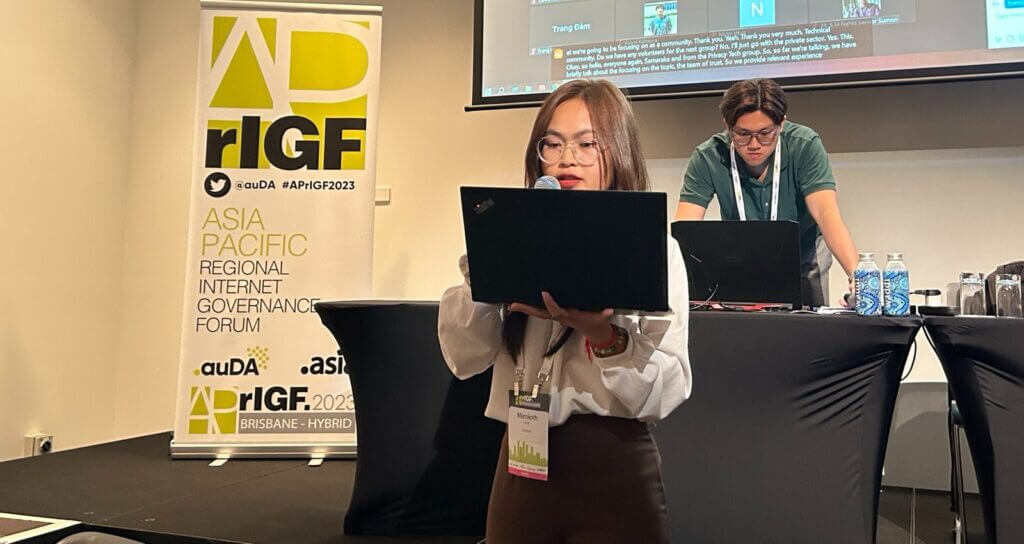
One of the amazing events I\'ve been to was the Asia Pacific Regional Internet Governance Forum (APrIGF) 2023, which took place in Brisbane, Australia. The APrIGF 2023 Overarching Theme is \" Emerging Technologies – Is Asia Pacific Ready for the Next Phase of the Internet?\". Young people and multi-stakeholders from various parts of Asia-Pacific have been invited to the table to discuss Internet governance. As a member of the CamyIGF 2023 organizing committee, I had the chance to interact and converse with a variety of stakeholders and young people from diverse regions.I\'ve never been this far away from home before, so I\'m truly amazed by Brisbane, Australia\'s beauty. From day 0 of the yIGF and APAC until the closing ceremony, I have learned immensely the primary role of youth in Internet governance, how we as young people are prepared to pursue these opportunities, and how we can contribute to the advancement of technology in our own society. The conference was hosted by the.au Domain Administration (auDA) sponsored by Asia Pacific Network Information Centre (APNIC), APNIC Foundation, NETTHING 2023, Australian Government and Internet Corporation for Assigned Names and Numbers (ICANN). The IGF basically aims to inform young people about Internet governance. It also encourages the younger generation to engage in more deliberation and decision-making process.The program agenda for yIGF 2023 and APrIGF includes the APAC Youth Leader dialogue on Youth Power Building Collaborative Partnership for Youth Inclusion Internet Governance, a panel discussion on algorithmic decision-making and the future of the Internet, a round table discussion on cyberspace\'s impact on youth digital wellbeing, and a meeting with industry experts. After each speaker’s presentation, there was an open floor dialogue followed by a panel discussion, where the speakers recap the discussion and receive follow-up questions from the participants. Participants can also ask their own questions to gain a deeper knowledge, and this is also one of the memorable moments when I see many enthusiastic young people and numerous stakeholders actively voicing their concerns!One of the highlights for me was getting to practice public speaking and boosting my confidence in expressing my concerns to the general public by presenting our Youth policy statement. The statement was the result of our discussion during the conference when we were divided into four groups made up of representatives from the Civil Society, the Technical Community, the Government, and the Private Sector.Everyone can participate in voicing their concerns about issues relating to Internet governance by doing so through the Youth Policy Statement in the APrIGF Synthesis Document 2023. If you\'re a Cambodian and are interested in learning more about Internet governance, join our Cambodia Youth Internet Governance Forum on September 23–24, 2023, at CADT!Photo by APNICFinally, I want to express my deepest gratitude to NetMission and the DotAsia Organization for giving me the chance to learn about Internet governance and develop my active participation, networking, and cooperation skills. Moreover, a special thanks to the organizing committee, who made sure that everyone is on the same page while continuing to provide us with all the essential materials from the day before the event to the last day of the conference. They put in a lot of effort, and I\'ve learned a lot from it, which has made me aspire to be like them. As a member of the yIGF 2023 Cambodia, I also want to offer my sincere gratitude to Open Development Cambodia for covering the cost of my roundtrip flight and visa.
My APrIGF 2023 Fellow Experience
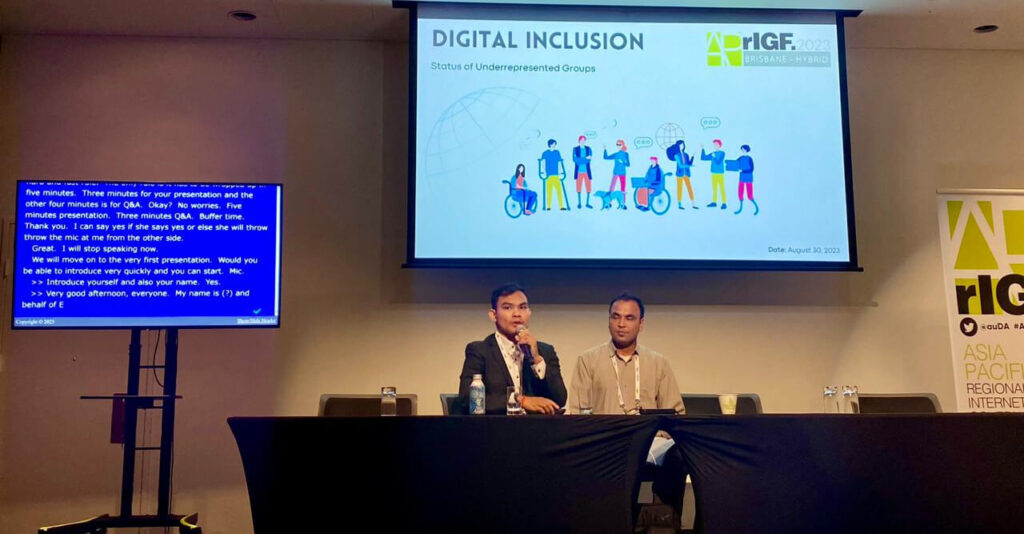
I am honored to be selected as one of the fellows for the Asia Pacific Regional Internet Governance Forum (APrIGF) held in Brisbane, Australia from 29th to 31st August 2023. The conference brings together a diverse group of people sharing different backgrounds, including youths, researchers, policymakers, and others, to collaborate and discuss Internet issues happening in the Asia Pacific region. This highlights the importance of multistakeholder approach to shape our digital space and Internet world.This year, it\'s noteworthy that the APrIGF, NetThing, Pacific IGF, and yIGF events were hosted concurrently at the Brisbane Convention & Exhibition Centre. The overarching theme for this year’s conference is “Emerging Technologies – Is Asia Pacific Ready for the Next Phase of the Internet?” with an emphasis on three main themes, access & inclusion, sustainability, and trust. In a world where technology is evolving rapidly, this forum pushed us to question our readiness, our strategies, and our ethical frameworks. Various interesting topics were discussed, such as data privacy and protection, AI ethics, cybersecurity, human rights, online child protection, digital inclusion and connectivity, policies and regulations, and many others.Day 0: Capacity building for fellows and newcomersBefore the official kick-off of the event, fellows and newcomers were invited to a capacity-building session. We were introduced to Internet governance and the multi-stakeholder model. The orientation helps to ensure that all attendees are welcomed, informed, and equipped with the knowledge necessary to actively participate in the forthcoming discussions in the following days, and everyone is open to raising their voices to shape the future of the Internet during the conference.We had an opportunity to stand up, introduce ourselves, and share our interests in Internet issues. It was enlightening to hear from such a diverse group, each bringing their unique perspective about Internet governance to the room. I also had the enriching experience of attending the APAC Youth Leaders Dialogue hosted by yIGF, which provided insights into how can the youth meaningfully contribute to Internet governance discussions and initiate local Internet governance in their home country. I also had the opportunity to discuss with the IGF secretariat. The discussion was not just about gaining knowledge but also about seeking advice, sharing concerns, and envisioning pathways for youth participation in the development of Internet policy.Day 1“Policy development on generative AI based on Biometrics & Weaponizing Information Bubbles” is one of the sessions I attended on the first day.The session is about the challenges we\'re facing with new AI technologies, especially the ones that create super realistic, yet fake content. The concerns around advanced AI technologies include voice synthesis that can mimic anyone\'s voice, deepfakes which can produce convincing videos of individuals doing or saying things they haven\'t, and even the ability to replicate unique identifiers such as fingerprints, and many more. Such advancements, powered by AI tools, blur the lines between reality and deceit. The session highlighted the importance of reflecting on why we use these technologies and what we hope to achieve with them. With AI\'s ability to generate almost real content, distinguishing genuine from fake is becoming a challenge.A significant concern raised was about AI\'s potential to disseminate false information widely and rapidly. But what\'s even more challenging is that our laws and regulations aren\'t adapted quickly enough to these technological advancements. This session raises our awareness of the need to exploit new technologies, understanding, and an emphasis on ethical use.Day 2In addition to the insightful sessions on Internet-related issues happening simultaneously on day 2, all the fellows had the opportunity to present their selected topics related to Internet issues within their buddy groups. It was an enriching learning experience to listen to the diverse perspectives everyone brought to the stage on Internet governance.I had a unique and new experience working with my buddy, Eshaq. Collaborating with someone who has a disability gives me insight into the challenges he is facing in relation to Internet governance. His perspective taught me that as technology is advancing, there is often a concerning oversight - the lack of prioritization and inclusion for underprivileged groups. Therefore, we decided to give a talk centered around the theme of “Inclusion.” Our primary goal was to emphasize the importance of inclusivity in today\'s digital world, ensuring that no one gets left behind as technology continues to evolve.Day 3On day 3, I had a chance to step up to the microphone during the Town Hall session to share my insights and to contribute to the Synthesis Document input – a collection of views and concerns about Internet governance in the Asia Pacific region. This document will be presented for further discussion at the Global IGF this October in Kyoto. The questions related to the three main themes are open for both online and onsite participants to share their thoughts.Access and InclusionDo emerging technologies bridge or widen the pre-existing digital divide in the Asia Pacific?How do they impact human rights, and how should policies respond?How can we ensure their affordability and equitable benefits?TrustHow can trust in the Internet, its infrastructure, and governance be strengthened?How can we balance trust and privacy? How can we ensure transparency, accountability and fairness in emerging technologies?How do we promote trust in complex, unfamiliar technologies?SustainabilityHow can new technologies support a sustainable Internet?How do we encourage sustainable development with these technologies?How do they contribute to an equitable future?Social EventsAttending the Asia Pacific Regional Internet Governance Forum (APrIGF) was not just a learning experience, but a golden opportunity to network with like-minded individuals passionate about Internet governance. We discussed the challenges and best practices related to Internet issues in our respective countries and region. Our fruitful and informal discussions led to further collaboration to work on Internet governance activities in our country.Photo by APNICTo everyone I had the pleasure of interacting with during APrIGF 2023, I extend my heartfelt gratitude. Your insights and experiences help me learn a lot, and come back with many new ideas. I would like to express my heartfelt gratitude to my mentor, Dr. Shabbir, as well as DotAsia and sponsors for granting me the opportunity to participate in this insightful conference and make significant impacts and success in the region. I am looking forward to further collaboration for a better and sustainable Internet world. Please mark your calendars for two upcoming Internet governance events:Cambodia Youth Internet Governance Forum: Scheduled for 23rd to 24th October 2023 at the Cambodia Academy of Digital Technology.18th Annual Meeting of the Internet Governance Forum: Scheduled for 8th to 12th October 2023 at Kyoto.
Cambodia YIGF’s First Debate Brings Spotlight On Internet Governance
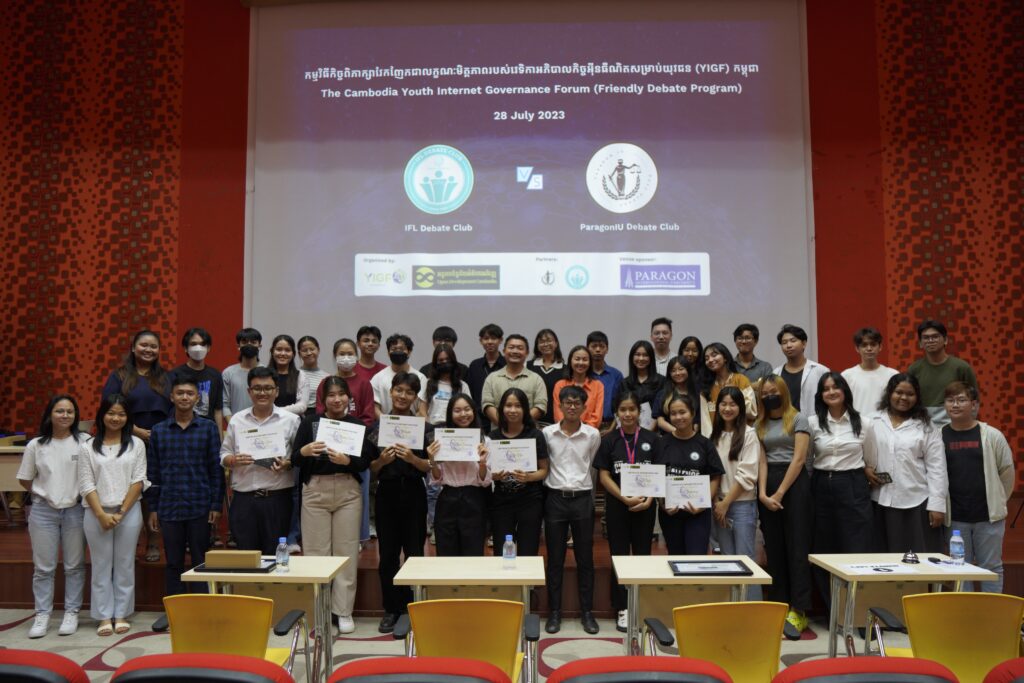
The Cambodia YIGF’s friendly debate debut brings the spotlight on ‘Internet Governance’ by bringing the internet aspects to be heard among youths and the public since internet governance is still a new topic in Cambodia.On July 28, the Cambodia Youth Internet Governance Forum (Cambodia YIGF) committees initiated the first friendly debate regarding internet governance topics to engage youths in the internet discussion. The very first debate program was joined by four main teams from two different universities: the Institute of Foreign Languages (IFL) of the Royal University of Phnom Penh (RUPP) and Paragon International University, with three members each. The Fancy Cookies team, Miyoshi Yumilinda, and Soun Ratana Somany, from IFL represented the government side, and the InExp team, Lovely Long, Elite Ek, and Chamroeun Chakri Chhoeung, from Paragon University, represented the opposition side. They debated the first motion, “This house believes youths should have a greater role in Internet Governance”.And for the second motion, “This house advocates for the inclusion of digital literacy programs in school curricula to promote online responsibility and empower individuals to navigate the digital landscape safely and ethically,” the e-Ninjas team, Nin Sreyleap, Kem Bunheang and Tith Mayana Khieu, from Paragon University, characterized the government-side debate between the opposition side from the Teletubbies team, Sros Sreyneang, Vong Daly, and Prom Menglong from IFL. The Cambodia YIGF Advisory Chhit Kanika remarked about how significant it is to understand more about Internet Governance in the digital age, and by initiating the first debate related to internet governance among youths, we will help foster youth engagement and awareness as well as the public’s through debating platforms. “In this era, where the internet basically involves our lives like ordering food, shopping, and dating, it is very important for everybody to understand the internet governance and also internet security in order to seize the opportunity and also identify the endangerment of the internet in the technology world.” Kanika said. She believed that throughout the debate session, participants would be able to learn more about internet governance from the debaters and be encouraged to engage with both oppositional and supportive arguments in order to get to know more about what internet governance is, especially for those who had never heard about it before. “And I hope that by the end of this first friendly debate, we will at least find some solutions to our problems and our misunderstandings related to these topics,” She added. At the end of the debate, the judges brought up some good advice for youth debaters and motivated them to keep learning and expanding their skills like researching, critical thinking, and body language. However, the judges all admired their debating skills. As they can come up with many impressive ideas regarding internet matters with data and dive deep into the solutions while debating on stage confidently, even internet governance is a new topic for them. The winner of the first motion went to the opposition side, the InExp team from Paragon University, and the winner of the second motion went to the opposition side, the Teletubbies team from IFL.

Internet use in Cambodia
The rise of internet usage in Cambodia is a sign of a digital revolution on a wider scale in different sectors for economic growth and digital lifestyle. However, regulation to better manage the internet and improvements in security and transparency in accessing the internet are needed to gain the full potential of the internet in an inclusive way.At the beginning of 2023, there were 11.37 million internet users in Cambodia, with a total of 22.16 million cellular mobile connections active, equivalent to 131.5 percent of the total population, according to Digital 2023: Cambodia. Cambodian internet users started to increase significantly during the COVID-19 pandemic with the demand for online purchasing and online learning, according to the Ministry of Posts and Telecommunications.E-commerceCambodian citizens found new ways of living more conveniently while beginning to adapt to the usage of digital money transactions through bank accounts instead of cash during the pandemic. This led to a boom in the e-commerce sector in Cambodia. Online selling and buying via social media apps, food delivery apps, school, healthcare, electricity, and water payments are also done digitally via QR codes. Payment begins to feel at ease, saving time and energy with your smartphone and with just a connection to the internet or Wi-Fi.According to Statista, Revenue in the e-commerce market is projected to reach US$979.90m in 2023. In the e-commerce market, the number of users is expected to amount to 8.76 million by 2027. The cyber law and e-commerce law to manage and protect consumers are needed to better govern the safety and security of the online market in Cambodia. However, online buying fraud, online money scamming, hacking, and data protection are the issues when it comes to online purchases.TourismThe findings show that there is a correlation when taking and planning tips; tourists consider the functionalities of social media as significant.Next, the most frequent source of information used by respondents when planning travel and trips is often social media (43.6%). The second most popular is family and friends (43.6%), of which the respondents often use their family or friends as their source of information. Also, mobile App sites (35.6%) are often used as the third source with tourism information (35.0%) as the last source, based on research about the \"Effect of Social Media in Tourism (Case in Cambodia)\".Therefore, social media platforms such as Facebook, Instagram, and TikTok, including Google search information and recommendations online for traveling destinations, are playing a crucial role in guiding and allowing tourists to access more information regarding their favorable traveling places in the country.Online EducationAccording to the Kiripost’s article (2023), the pandemic has led to a significant increase in online education in Cambodia, with at least three students enrolled in online courses. This has created great opportunities for online education businesses to enter the Cambodian market, with regional income from online education is projected to reach $1,485 million in 2022 and $2,555 million by 2026. However, a survey found that 78% of students prefer hybrid learning, while 14% prefer online education.According to a report by the Cambodian Education Forum (2021), online learning has revolutionized the way students learn, particularly in higher education by allowing access to technology tools, digital platforms, and the Internet. The official MoEYS Facebook page, YouTube channel, and other e-learning platforms offer over 200 video lessons, allowing students to access online learning anytime and anywhere. This innovative method of learning saves money and time, making higher education more hybrid and transformative on a global scale. Digital education has also supported the development of competency-based teaching strategies, as UNESCO states that teachers receiving high-quality support, including new teaching approaches, learning activities, and hygienic supplies, ensure continuous education for learners (Cambodianess, 2020).Social Media & EntertainmentCambodia’s entertainment industry is transforming to digital platforms and social media such as Youtube, Spotify, Facebook, Instagram, TikTok, and Telegram. Music videos, news, and a variety of content go online.Cambodia’s digital media market was valued at $74.87 million in 2022, a 17 percent growth from 2021. Video games make up the largest segment, worth $38.7 million in 2022, a 16.5 rise from 2021. Digital music revenue in 2022 was valued at $6.5 million, capturing only nine percent of the market share.Since the Internet is used widely and productively in various sectors in Cambodia, such as e-commerce, tourism, education, and entertainment. Safety and security with inclusive use of the internet are necessary to ensure everyone can obtain the opportunity and benefits of digital tools without harm or scams via cyberspace. Digital Government Infrastructure and Cyber Security are key strategic thrusts to ensure the quality, efficiency, and security of networks in the Kingdom.

The Origins of the Internet
The origins of the internet are rooted in the USA of the 1950s. The Cold War was at its height and huge tensions existed between North America and the Soviet Union. The intensity between these two superpowers led people to live in fear of the nuclear weapons possessed by two countries and the US realized it needed a communications system that could not be affected by a Soviet nuclear attack by establishing an independent communication method using the internet.At that time, computers were large, expensive machines exclusively used by military scientists and university staff only.The Internet started in the 1960s as a way for government researchers to share information. January 1, 1983 is considered the official birthday of the Internet.The Internet is the global system of interconnected computer networks that uses the Internet protocol suite (TCP/IP) to communicate between networks and devices. It is a network of networks that consists of private, public, academic, business, and government networks of local to global scope, linked by a broad array of electronic, wireless, and optical networking technologies.Do you know when Cambodia first used the internet?Cambodia started using the Internet for the first time in 1997, the opening history of the Internet era in Cambodia also begins during that time. The very first internet service provided was called Camnet Internet Service. The Camnet Internet Service is an Internet service provider operated by the Ministry of Posts and Telecommunications of Cambodia with the support of the International Development Research Centre of Canada. It has its headquarters in Phnom Penh city.Cambodia was connected to the internet via a 64 Kilobytes per second (kbps) satellite link to Singapore in May 1997.Meanwhile, Camnet had connected over 90 users and is taking on commercial clients, whileproviding a heavily subsidized service to government ministries, universities, and Cambodian NGOs for its first-time operation in cyberspace in Cambodia.On the commercial front, Camnet already faced stiff competition from a second Internet service, Big Pond, which was launched by the Australian telecommunications giant, Telstra, on June 2 1997. At that time in 2001, Cambodia internet price was based on prepaid internet cards, which cost approximately $3.33 per hour from the internet provider service (IPS) like Camnet, according to one case study report of the International Telecommunication Union Geneva, Switzerland. Messages used to cost $0.15 per kilobyte, which is about 150 characters of text. There is an hourly charge for dial-up Public Private Partner (PPP), so unless the files were truly enormous (software downloads, for example), the cost to receive them in Cambodia is negligible. Since the cost of the internet was high, the internet connectivity was limited even in Phnom Penh and Siem Reap province had access to the internet, however, there were few Internet Cafes that initiated internet accessibility while there was no public access in the remote areas.Cambodia’s Recent Internet ExpansionLater on, the kingdom’s cyber world would become increasingly important. About 15 years later, the Internet has evolved into a central source for entertainment and information for much of Cambodia’s upper and middle classes. These changes began with the entrance of the first Internet Service Providers (ISPs) such as Big Pond and CamNet, into Cambodia, allowing a small group of people to access the Internet at a few coffee shops around the city. Nowadays, the internet and Wi-Fi are quite common in Cambodia with low prices and people can stay in touch with the online world almost everywhere including the coffee shops, restaurants, hotels, office buildings, houses and some public places that offer free Wi-Fi for the public and customers.There were 11.37 million internet users in Cambodia in January 2023, according to the Data Reportal report, Digital 2023: Cambodia. Access to the internet is now critical in the lives of Cambodians. Almost every element of our everyday life is linked to digital devices and cyberspace in the way we interact, share information, entertain, e-learning, money transfer, online shopping, and work remotely, among other things.
Internet use in Cambodia
The rise of internet usage in Cambodia is a sign of a digital revolution on a wider scale in different sectors for economic growth and digital lifestyle. However, regulation to better manage the internet and improvements in security and transparency in accessing the internet are needed to gain the full potential of the internet in an inclusive way.At the beginning of 2023, there were 11.37 million internet users in Cambodia, with a total of 22.16 million cellular mobile connections active, equivalent to 131.5 percent of the total population, according to Digital 2023: Cambodia. Cambodian internet users started to increase significantly during the COVID-19 pandemic with the demand for online purchasing and online learning, according to the Ministry of Posts and Telecommunications.E-commerceCambodian citizens found new ways of living more conveniently while beginning to adapt to the usage of digital money transactions through bank accounts instead of cash during the pandemic. This led to a boom in the e-commerce sector in Cambodia. Online selling and buying via social media apps, food delivery apps, school, healthcare, electricity, and water payments are also done digitally via QR codes. Payment begins to feel at ease, saving time and energy with your smartphone and with just a connection to the internet or Wi-Fi.According to Statista, Revenue in the e-commerce market is projected to reach US$979.90m in 2023. In the e-commerce market, the number of users is expected to amount to 8.76 million by 2027. The cyber law and e-commerce law to manage and protect consumers are needed to better govern the safety and security of the online market in Cambodia. However, online buying fraud, online money scamming, hacking, and data protection are the issues when it comes to online purchases.TourismThe findings show that there is a correlation when taking and planning tips; tourists consider the functionalities of social media as significant.Next, the most frequent source of information used by respondents when planning travel and trips is often social media (43.6%). The second most popular is family and friends (43.6%), of which the respondents often use their family or friends as their source of information. Also, mobile App sites (35.6%) are often used as the third source with tourism information (35.0%) as the last source, based on research about the \"Effect of Social Media in Tourism (Case in Cambodia)\".Therefore, social media platforms such as Facebook, Instagram, and TikTok, including Google search information and recommendations online for traveling destinations, are playing a crucial role in guiding and allowing tourists to access more information regarding their favorable traveling places in the country.Online EducationAccording to the Kiripost’s article (2023), the pandemic has led to a significant increase in online education in Cambodia, with at least three students enrolled in online courses. This has created great opportunities for online education businesses to enter the Cambodian market, with regional income from online education is projected to reach $1,485 million in 2022 and $2,555 million by 2026. However, a survey found that 78% of students prefer hybrid learning, while 14% prefer online education.According to a report by the Cambodian Education Forum (2021), online learning has revolutionized the way students learn, particularly in higher education by allowing access to technology tools, digital platforms, and the Internet. The official MoEYS Facebook page, YouTube channel, and other e-learning platforms offer over 200 video lessons, allowing students to access online learning anytime and anywhere. This innovative method of learning saves money and time, making higher education more hybrid and transformative on a global scale. Digital education has also supported the development of competency-based teaching strategies, as UNESCO states that teachers receiving high-quality support, including new teaching approaches, learning activities, and hygienic supplies, ensure continuous education for learners (Cambodianess, 2020).Social Media & EntertainmentCambodia’s entertainment industry is transforming to digital platforms and social media such as Youtube, Spotify, Facebook, Instagram, TikTok, and Telegram. Music videos, news, and a variety of content go online.Cambodia’s digital media market was valued at $74.87 million in 2022, a 17 percent growth from 2021. Video games make up the largest segment, worth $38.7 million in 2022, a 16.5 rise from 2021. Digital music revenue in 2022 was valued at $6.5 million, capturing only nine percent of the market share.Since the Internet is used widely and productively in various sectors in Cambodia, such as e-commerce, tourism, education, and entertainment. Safety and security with inclusive use of the internet are necessary to ensure everyone can obtain the opportunity and benefits of digital tools without harm or scams via cyberspace. Digital Government Infrastructure and Cyber Security are key strategic thrusts to ensure the quality, efficiency, and security of networks in the Kingdom.
The Origins of the Internet
The origins of the internet are rooted in the USA of the 1950s. The Cold War was at its height and huge tensions existed between North America and the Soviet Union. The intensity between these two superpowers led people to live in fear of the nuclear weapons possessed by two countries and the US realized it needed a communications system that could not be affected by a Soviet nuclear attack by establishing an independent communication method using the internet.At that time, computers were large, expensive machines exclusively used by military scientists and university staff only.The Internet started in the 1960s as a way for government researchers to share information. January 1, 1983 is considered the official birthday of the Internet.The Internet is the global system of interconnected computer networks that uses the Internet protocol suite (TCP/IP) to communicate between networks and devices. It is a network of networks that consists of private, public, academic, business, and government networks of local to global scope, linked by a broad array of electronic, wireless, and optical networking technologies.Do you know when Cambodia first used the internet?Cambodia started using the Internet for the first time in 1997, the opening history of the Internet era in Cambodia also begins during that time. The very first internet service provided was called Camnet Internet Service. The Camnet Internet Service is an Internet service provider operated by the Ministry of Posts and Telecommunications of Cambodia with the support of the International Development Research Centre of Canada. It has its headquarters in Phnom Penh city.Cambodia was connected to the internet via a 64 Kilobytes per second (kbps) satellite link to Singapore in May 1997.Meanwhile, Camnet had connected over 90 users and is taking on commercial clients, whileproviding a heavily subsidized service to government ministries, universities, and Cambodian NGOs for its first-time operation in cyberspace in Cambodia.On the commercial front, Camnet already faced stiff competition from a second Internet service, Big Pond, which was launched by the Australian telecommunications giant, Telstra, on June 2 1997. At that time in 2001, Cambodia internet price was based on prepaid internet cards, which cost approximately $3.33 per hour from the internet provider service (IPS) like Camnet, according to one case study report of the International Telecommunication Union Geneva, Switzerland. Messages used to cost $0.15 per kilobyte, which is about 150 characters of text. There is an hourly charge for dial-up Public Private Partner (PPP), so unless the files were truly enormous (software downloads, for example), the cost to receive them in Cambodia is negligible. Since the cost of the internet was high, the internet connectivity was limited even in Phnom Penh and Siem Reap province had access to the internet, however, there were few Internet Cafes that initiated internet accessibility while there was no public access in the remote areas.Cambodia’s Recent Internet ExpansionLater on, the kingdom’s cyber world would become increasingly important. About 15 years later, the Internet has evolved into a central source for entertainment and information for much of Cambodia’s upper and middle classes. These changes began with the entrance of the first Internet Service Providers (ISPs) such as Big Pond and CamNet, into Cambodia, allowing a small group of people to access the Internet at a few coffee shops around the city. Nowadays, the internet and Wi-Fi are quite common in Cambodia with low prices and people can stay in touch with the online world almost everywhere including the coffee shops, restaurants, hotels, office buildings, houses and some public places that offer free Wi-Fi for the public and customers.There were 11.37 million internet users in Cambodia in January 2023, according to the Data Reportal report, Digital 2023: Cambodia. Access to the internet is now critical in the lives of Cambodians. Almost every element of our everyday life is linked to digital devices and cyberspace in the way we interact, share information, entertain, e-learning, money transfer, online shopping, and work remotely, among other things.
My experience after the event in Brisbane– yIGF & APrIGF 2023
One of the amazing events I\'ve been to was the Asia Pacific Regional Internet Governance Forum (APrIGF) 2023, which took place in Brisbane, Australia. The APrIGF 2023 Overarching Theme is \" Emerging Technologies – Is Asia Pacific Ready for the Next Phase of the Internet?\". Young people and multi-stakeholders from various parts of Asia-Pacific have been invited to the table to discuss Internet governance. As a member of the CamyIGF 2023 organizing committee, I had the chance to interact and converse with a variety of stakeholders and young people from diverse regions.I\'ve never been this far away from home before, so I\'m truly amazed by Brisbane, Australia\'s beauty. From day 0 of the yIGF and APAC until the closing ceremony, I have learned immensely the primary role of youth in Internet governance, how we as young people are prepared to pursue these opportunities, and how we can contribute to the advancement of technology in our own society. The conference was hosted by the.au Domain Administration (auDA) sponsored by Asia Pacific Network Information Centre (APNIC), APNIC Foundation, NETTHING 2023, Australian Government and Internet Corporation for Assigned Names and Numbers (ICANN). The IGF basically aims to inform young people about Internet governance. It also encourages the younger generation to engage in more deliberation and decision-making process.The program agenda for yIGF 2023 and APrIGF includes the APAC Youth Leader dialogue on Youth Power Building Collaborative Partnership for Youth Inclusion Internet Governance, a panel discussion on algorithmic decision-making and the future of the Internet, a round table discussion on cyberspace\'s impact on youth digital wellbeing, and a meeting with industry experts. After each speaker’s presentation, there was an open floor dialogue followed by a panel discussion, where the speakers recap the discussion and receive follow-up questions from the participants. Participants can also ask their own questions to gain a deeper knowledge, and this is also one of the memorable moments when I see many enthusiastic young people and numerous stakeholders actively voicing their concerns!One of the highlights for me was getting to practice public speaking and boosting my confidence in expressing my concerns to the general public by presenting our Youth policy statement. The statement was the result of our discussion during the conference when we were divided into four groups made up of representatives from the Civil Society, the Technical Community, the Government, and the Private Sector.Everyone can participate in voicing their concerns about issues relating to Internet governance by doing so through the Youth Policy Statement in the APrIGF Synthesis Document 2023. If you\'re a Cambodian and are interested in learning more about Internet governance, join our Cambodia Youth Internet Governance Forum on September 23–24, 2023, at CADT!Photo by APNICFinally, I want to express my deepest gratitude to NetMission and the DotAsia Organization for giving me the chance to learn about Internet governance and develop my active participation, networking, and cooperation skills. Moreover, a special thanks to the organizing committee, who made sure that everyone is on the same page while continuing to provide us with all the essential materials from the day before the event to the last day of the conference. They put in a lot of effort, and I\'ve learned a lot from it, which has made me aspire to be like them. As a member of the yIGF 2023 Cambodia, I also want to offer my sincere gratitude to Open Development Cambodia for covering the cost of my roundtrip flight and visa.
My APrIGF 2023 Fellow Experience
I am honored to be selected as one of the fellows for the Asia Pacific Regional Internet Governance Forum (APrIGF) held in Brisbane, Australia from 29th to 31st August 2023. The conference brings together a diverse group of people sharing different backgrounds, including youths, researchers, policymakers, and others, to collaborate and discuss Internet issues happening in the Asia Pacific region. This highlights the importance of multistakeholder approach to shape our digital space and Internet world.This year, it\'s noteworthy that the APrIGF, NetThing, Pacific IGF, and yIGF events were hosted concurrently at the Brisbane Convention & Exhibition Centre. The overarching theme for this year’s conference is “Emerging Technologies – Is Asia Pacific Ready for the Next Phase of the Internet?” with an emphasis on three main themes, access & inclusion, sustainability, and trust. In a world where technology is evolving rapidly, this forum pushed us to question our readiness, our strategies, and our ethical frameworks. Various interesting topics were discussed, such as data privacy and protection, AI ethics, cybersecurity, human rights, online child protection, digital inclusion and connectivity, policies and regulations, and many others.Day 0: Capacity building for fellows and newcomersBefore the official kick-off of the event, fellows and newcomers were invited to a capacity-building session. We were introduced to Internet governance and the multi-stakeholder model. The orientation helps to ensure that all attendees are welcomed, informed, and equipped with the knowledge necessary to actively participate in the forthcoming discussions in the following days, and everyone is open to raising their voices to shape the future of the Internet during the conference.We had an opportunity to stand up, introduce ourselves, and share our interests in Internet issues. It was enlightening to hear from such a diverse group, each bringing their unique perspective about Internet governance to the room. I also had the enriching experience of attending the APAC Youth Leaders Dialogue hosted by yIGF, which provided insights into how can the youth meaningfully contribute to Internet governance discussions and initiate local Internet governance in their home country. I also had the opportunity to discuss with the IGF secretariat. The discussion was not just about gaining knowledge but also about seeking advice, sharing concerns, and envisioning pathways for youth participation in the development of Internet policy.Day 1“Policy development on generative AI based on Biometrics & Weaponizing Information Bubbles” is one of the sessions I attended on the first day.The session is about the challenges we\'re facing with new AI technologies, especially the ones that create super realistic, yet fake content. The concerns around advanced AI technologies include voice synthesis that can mimic anyone\'s voice, deepfakes which can produce convincing videos of individuals doing or saying things they haven\'t, and even the ability to replicate unique identifiers such as fingerprints, and many more. Such advancements, powered by AI tools, blur the lines between reality and deceit. The session highlighted the importance of reflecting on why we use these technologies and what we hope to achieve with them. With AI\'s ability to generate almost real content, distinguishing genuine from fake is becoming a challenge.A significant concern raised was about AI\'s potential to disseminate false information widely and rapidly. But what\'s even more challenging is that our laws and regulations aren\'t adapted quickly enough to these technological advancements. This session raises our awareness of the need to exploit new technologies, understanding, and an emphasis on ethical use.Day 2In addition to the insightful sessions on Internet-related issues happening simultaneously on day 2, all the fellows had the opportunity to present their selected topics related to Internet issues within their buddy groups. It was an enriching learning experience to listen to the diverse perspectives everyone brought to the stage on Internet governance.I had a unique and new experience working with my buddy, Eshaq. Collaborating with someone who has a disability gives me insight into the challenges he is facing in relation to Internet governance. His perspective taught me that as technology is advancing, there is often a concerning oversight - the lack of prioritization and inclusion for underprivileged groups. Therefore, we decided to give a talk centered around the theme of “Inclusion.” Our primary goal was to emphasize the importance of inclusivity in today\'s digital world, ensuring that no one gets left behind as technology continues to evolve.Day 3On day 3, I had a chance to step up to the microphone during the Town Hall session to share my insights and to contribute to the Synthesis Document input – a collection of views and concerns about Internet governance in the Asia Pacific region. This document will be presented for further discussion at the Global IGF this October in Kyoto. The questions related to the three main themes are open for both online and onsite participants to share their thoughts.Access and InclusionDo emerging technologies bridge or widen the pre-existing digital divide in the Asia Pacific?How do they impact human rights, and how should policies respond?How can we ensure their affordability and equitable benefits?TrustHow can trust in the Internet, its infrastructure, and governance be strengthened?How can we balance trust and privacy? How can we ensure transparency, accountability and fairness in emerging technologies?How do we promote trust in complex, unfamiliar technologies?SustainabilityHow can new technologies support a sustainable Internet?How do we encourage sustainable development with these technologies?How do they contribute to an equitable future?Social EventsAttending the Asia Pacific Regional Internet Governance Forum (APrIGF) was not just a learning experience, but a golden opportunity to network with like-minded individuals passionate about Internet governance. We discussed the challenges and best practices related to Internet issues in our respective countries and region. Our fruitful and informal discussions led to further collaboration to work on Internet governance activities in our country.Photo by APNICTo everyone I had the pleasure of interacting with during APrIGF 2023, I extend my heartfelt gratitude. Your insights and experiences help me learn a lot, and come back with many new ideas. I would like to express my heartfelt gratitude to my mentor, Dr. Shabbir, as well as DotAsia and sponsors for granting me the opportunity to participate in this insightful conference and make significant impacts and success in the region. I am looking forward to further collaboration for a better and sustainable Internet world. Please mark your calendars for two upcoming Internet governance events:Cambodia Youth Internet Governance Forum: Scheduled for 23rd to 24th October 2023 at the Cambodia Academy of Digital Technology.18th Annual Meeting of the Internet Governance Forum: Scheduled for 8th to 12th October 2023 at Kyoto.
Cambodia YIGF’s First Debate Brings Spotlight On Internet Governance
The Cambodia YIGF’s friendly debate debut brings the spotlight on ‘Internet Governance’ by bringing the internet aspects to be heard among youths and the public since internet governance is still a new topic in Cambodia.On July 28, the Cambodia Youth Internet Governance Forum (Cambodia YIGF) committees initiated the first friendly debate regarding internet governance topics to engage youths in the internet discussion. The very first debate program was joined by four main teams from two different universities: the Institute of Foreign Languages (IFL) of the Royal University of Phnom Penh (RUPP) and Paragon International University, with three members each. The Fancy Cookies team, Miyoshi Yumilinda, and Soun Ratana Somany, from IFL represented the government side, and the InExp team, Lovely Long, Elite Ek, and Chamroeun Chakri Chhoeung, from Paragon University, represented the opposition side. They debated the first motion, “This house believes youths should have a greater role in Internet Governance”.And for the second motion, “This house advocates for the inclusion of digital literacy programs in school curricula to promote online responsibility and empower individuals to navigate the digital landscape safely and ethically,” the e-Ninjas team, Nin Sreyleap, Kem Bunheang and Tith Mayana Khieu, from Paragon University, characterized the government-side debate between the opposition side from the Teletubbies team, Sros Sreyneang, Vong Daly, and Prom Menglong from IFL. The Cambodia YIGF Advisory Chhit Kanika remarked about how significant it is to understand more about Internet Governance in the digital age, and by initiating the first debate related to internet governance among youths, we will help foster youth engagement and awareness as well as the public’s through debating platforms. “In this era, where the internet basically involves our lives like ordering food, shopping, and dating, it is very important for everybody to understand the internet governance and also internet security in order to seize the opportunity and also identify the endangerment of the internet in the technology world.” Kanika said. She believed that throughout the debate session, participants would be able to learn more about internet governance from the debaters and be encouraged to engage with both oppositional and supportive arguments in order to get to know more about what internet governance is, especially for those who had never heard about it before. “And I hope that by the end of this first friendly debate, we will at least find some solutions to our problems and our misunderstandings related to these topics,” She added. At the end of the debate, the judges brought up some good advice for youth debaters and motivated them to keep learning and expanding their skills like researching, critical thinking, and body language. However, the judges all admired their debating skills. As they can come up with many impressive ideas regarding internet matters with data and dive deep into the solutions while debating on stage confidently, even internet governance is a new topic for them. The winner of the first motion went to the opposition side, the InExp team from Paragon University, and the winner of the second motion went to the opposition side, the Teletubbies team from IFL.